Updated September 2026. Written and checked by the technicians at Safe & Secure Locksmith, 4105 Macdonald St, Vancouver. Every figure below matches our published price list. Call 604-734-7233 for a quote before anyone is dispatched.
Events, not dates
The common answer is once a year, and it is the wrong shape. Annual rekeying is expensive and still leaves you exposed for up to eleven months after the key you should have worried about walked out the door.
Rekey on events. There are five that matter, and if you handle them, the calendar takes care of itself.
The five triggers
1. Someone with a key leaves
Any departure where a keyholder does not return every key, and any departure that was not on good terms. A returned key proves nothing on its own: copies are trivial to make on standard hardware.
2. A key goes missing
Lost, stolen, or unaccounted for at an audit. Treat unaccounted for the same as lost, because that is what it is.
3. A contractor or vendor finishes
Fit-outs and renovations hand keys to trades, and those keys travel between sites and crews. Rekey at project completion as part of the sign-off, not months later.
4. A tenant moves out
Between every tenancy, without exception. It is the cheapest way to close a key population you do not control, and it removes any later argument about who had access.
5. Any security incident
A break-in, an unexplained entry, stock or cash gone with no forced entry. If it looks like someone had a key, act as though they did.
What it costs
Rekeying is $25 to $45 per cylinder for standard hardware and $60 to $120 per cylinder for high-security platforms, on top of a $75 service call during standard hours. A commercial lock change, where hardware has to be swapped rather than repinned, is $80 to $380 per door depending on the hardware. Published on the prices page.
Set against the cost of a stock loss, an insurance claim complicated by no sign of forced entry, or a staff-safety incident, a per-cylinder rekey is the cheapest control in the building.
Do not rekey everything every time
You rarely need the whole site. Rekey the group the departing keyholder could open. That is the practical argument for a master key system: it structures your doors into groups, so a departure means repinning one floor rather than forty doors. The design is described in master key systems explained.
Key control removes most of the problem
Rekeying is a reaction. Key control is the thing that stops you needing to react so often.
Keep a register: which key, which doors, who holds it, when it was issued, when it came back. Number the keys and stamp do not duplicate on them, understanding that stamping is a deterrent and not a barrier on standard hardware. Do a physical audit twice a year and reconcile it against the register.
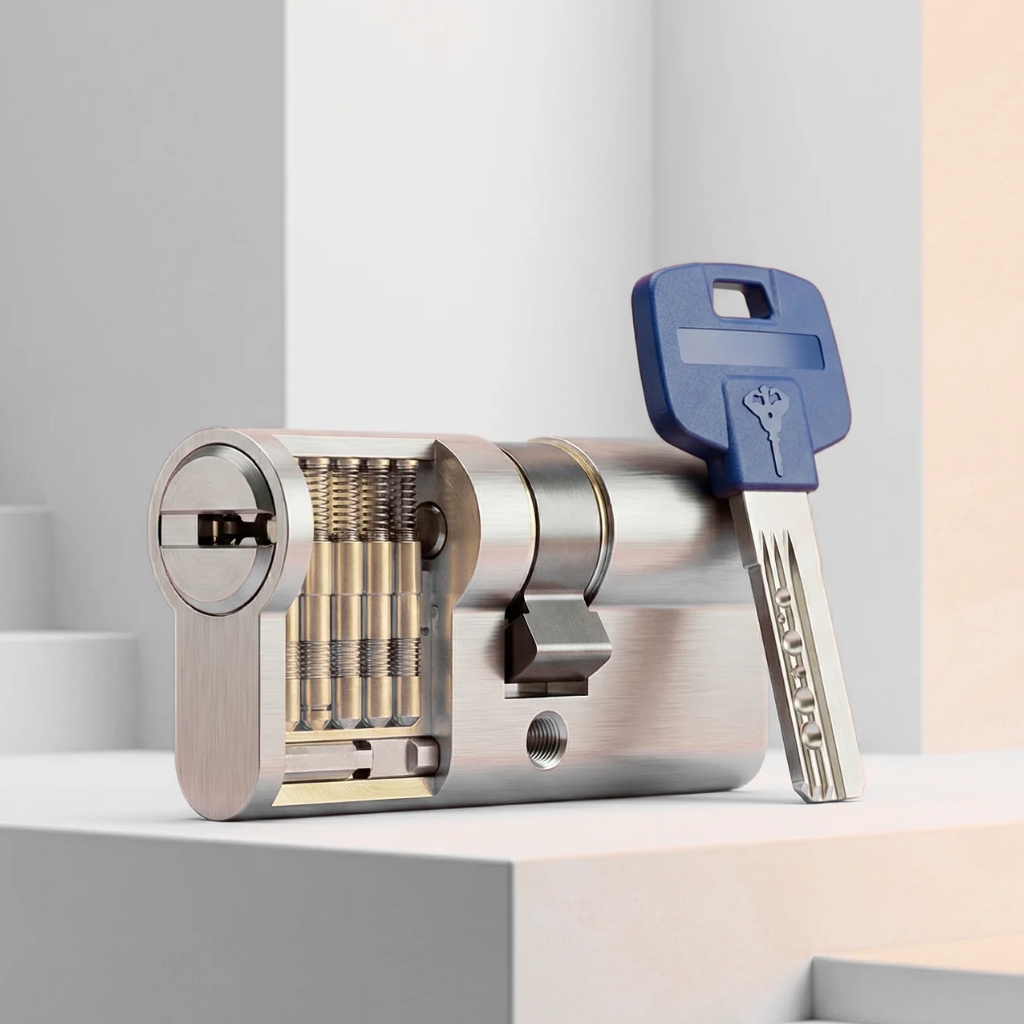
The real barrier is a restricted keyway, where blanks are not available to the public and copies are cut only to a registered code with authorisation. That converts a policy into a mechanism: see high security locks and the Mul-T-Lock interactive system.
Where electronic access fits
Electronic access control solves the departure problem differently: you revoke a credential in software instead of repinning a cylinder, and you get an audit trail of who opened what and when. For a site with frequent staff turnover that is a genuinely better model.
It is not a complete answer. Almost every electronic system has a mechanical override, and that override is a key someone holds. Doors on the perimeter that are not on the system still need conventional control. A mixed site is normal, and it needs both disciplines. The service page is commercial locksmith.
A baseline schedule
Rekey on every one of the five triggers above. Audit keys against the register every six months. Review the register whenever anyone's role changes. And walk the perimeter once a year looking at the parts that are not the cylinder: strike plates, frames, door closers, hinges and the back door nobody uses. Most forced entry is at those points, which is the case made in how burglars actually get in.
Landlords and property managers
For rental property the rule is simplest of all: rekey between every tenancy, and put it in the turnover checklist beside the cleaning and the inspection. Tenants have keys cut for partners, family and friends over a lease, and none of that is unreasonable, but none of it should carry into the next tenancy either. The comparison with replacing hardware is in rekeying versus replacing.
Article history
Updated September 2026, with commercial pricing checked against the shop sheet. To scope a site, call 604-734-7233 or book a time.