A bump key is cut to the deepest depth at every position. Struck under light turning pressure, it bounces the pins of a standard pin-tumbler lock past the shear line for a split second. Locks built on telescoping pins, sidebars or rotating discs (Mul-T-Lock, Medeco, Abloy) defeat it, and a restricted keyway stops the blank from existing.
Updated September 2026. Written and checked by the technicians at Safe & Secure Locksmith, 4105 Macdonald St, Vancouver. Prices below match our published price list.
What a bump key is and why standard pin-tumbler locks are vulnerable
Almost every deadbolt and knob lock sold at a Vancouver hardware counter is a pin-tumbler lock. Inside the cylinder sit five or six stacks of pins, each a key pin under a driver pin with a spring on top. The right key lifts every stack so the split between the two pins meets the shear line, and the plug turns.
A bump key is cut to the maximum depth at every position, so it enters any lock on that keyway. A sharp tap sends an impulse up each stack: the key pins stay put and the driver pins jump, the way the far ball on a desk toy flies off when the near one strikes. For an instant every gap sits at the shear line.
The technique works because nothing in an ordinary cylinder asks the key for anything except height. It fails the moment a second element has to be satisfied at the same time, which is the idea behind every lock in the table below.
Is lock bumping legal in Canada?
Owning a bump key is not, by itself, an offence. Section 351 of the Criminal Code makes it an offence to possess, without lawful excuse, an instrument suitable for breaking into a place, motor vehicle, vault or safe, knowing that it has been or is intended to be used for that purpose. It is a hybrid offence, with up to ten years on indictment.
Lawful excuse and knowledge do the work. A locksmith carrying picks and bump keys to a lockout has a lawful excuse, and in BC the trade is regulated: the Security Services Act lists locksmiths as a security business and requires a licence to operate. Someone at your door at 2 am with a bump key set and no reason to be there is in a very different position.
Bump keys and pick sets are sold openly online, so the law is not what protects your door. The hardware is.
Signs your lock has been bumped, and why there usually are none
Bumping leaves the door, the frame and the lock intact, which is exactly why it worries people. No splintered jamb, no pried strike plate, no drilled cylinder. At most a technician with the cylinder on the bench finds small bright marks at the bottom of the keyway or faint dents on the pin tips, and neither shows from the porch.
So the sign is usually the absence of one: things missing behind a locked door with no forced entry. If that happens, file a police report, tell your insurer plainly that there was no visible damage, and have the cylinder inspected before concluding it was bumped. Most Metro Vancouver break-ins still go through a weak frame or an unlocked window, and the cheap fixes for those are in how burglars actually get in.
Bump-resistant lock designs: telescoping pins, sidebars and rotating discs
Every bump-resistant cylinder adds a second thing the key must do besides lift pins to a height.
- Sidebars. A bar along the plug retracts only when a second feature on the key, a milled groove or a set of side pins, sits in the right place. Bouncing the main pins does nothing for it. Medeco, Schlage Primus and Mul-T-Lock all use one.
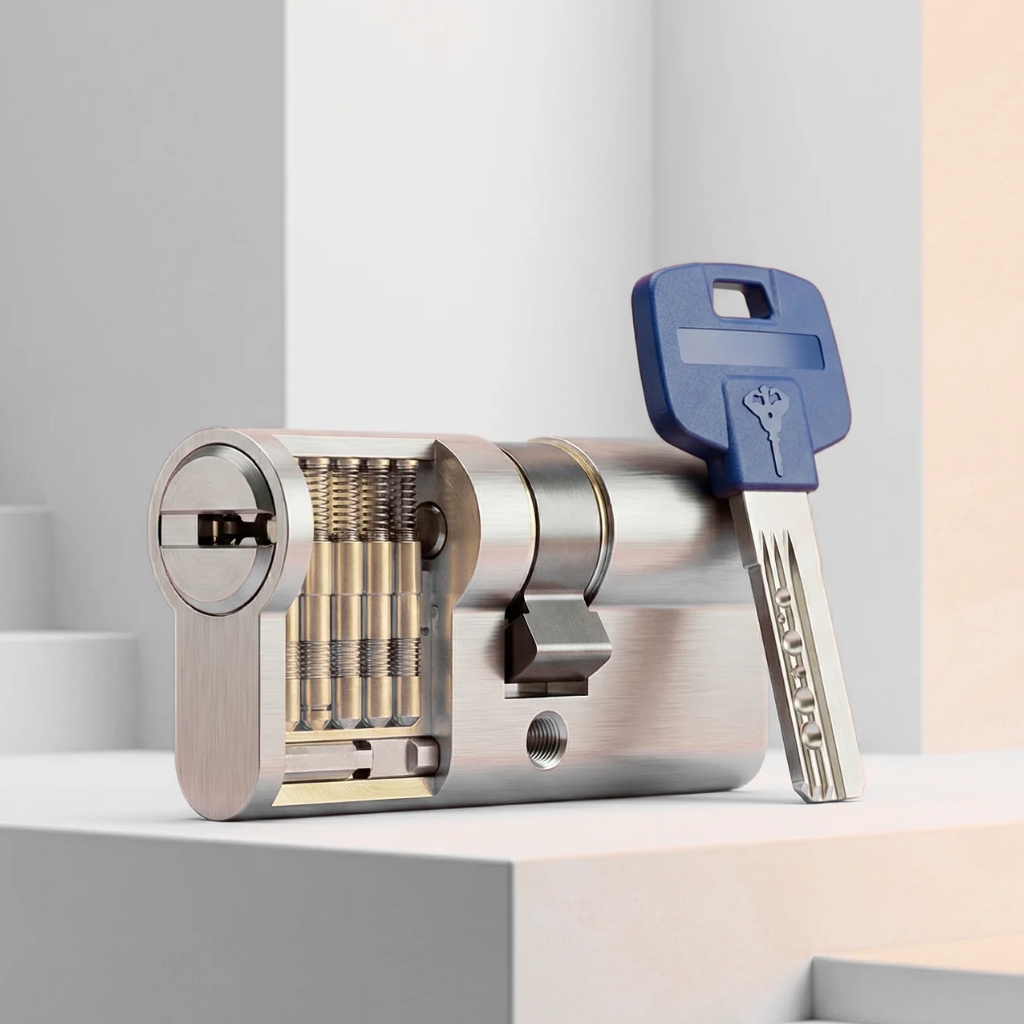
- Telescoping pins. A pin inside a pin, each with its own shear line, so one impulse cannot set both layers at once. This is the Mul-T-Lock signature.
- Rotating discs. Abloy replaces pins and springs with a stack of discs the key turns to set angles, like a small combination lock. No spring, so nothing for a bump key to act on.
- Security pins and sidebar wafers. Spool and serrated driver pins make an ordinary cylinder harder to bump but not immune. Kwikset SmartKey drops the pin stacks for a sidebar-and-wafer design that Kwikset rates as bump proof and pick resistant.
- Restricted keyways. Not a mechanical defence, but the one that stops the blank existing. No blank in the right profile, no bump key to cut.
Two standards separate tested cylinders from marketed ones. UL 437, the Standard for Key Locks, puts cylinders through timed picking, impressioning, drilling, sawing, prying and pulling attacks. ANSI/BHMA A156.30 grades high-security cylinders on key control, destructive resistance and surreptitious-entry resistance in levels A to C, with C the highest.
Mul-T-Lock vs Medeco vs Abloy: how each stops bumping and picking
Mul-T-Lock. The current platform is MTL800, which Mul-T-Lock describes as fully backward compatible with the MT5+ it succeeds. Each chamber holds a telescoping pin within a pin, a separate locking bar must be satisfied by a milled track on the key, and a sprung element at the key tip, the alpha spring, engages a further pin at the rear of the cylinder. Three independent mechanisms on a patented restricted keyway; the platforms we fit and register are on our Mul-T-Lock dealer page.
Medeco. In a Medeco 4 cylinder the pins must be lifted and rotated to the correct angle before a sidebar can retract, and four side pins, three finger pins and one lift pin, add a second layer. The lift pin is moved by a small movable element in the key itself, which Medeco says also protects against 3D-printed copies. It is the traditional choice where an insurer or a specification names UL 437.
Abloy. Protec2 has no pins and no springs. The key rotates a stack of discs to set positions, false gates confuse manipulation, and a disc blocking system locks the discs together as one unit if anything other than the right key tries to move them. Abloy calls it fully resistant to bumping, its patent runs to 2031, and it is the usual answer for padlocks, gates and anything left out in the weather.
| Design | Bumping | Picking | Drilling | Key control |
|---|
| Standard pin tumbler (builder-grade Kwikset, Schlage, Weiser) | Vulnerable | Vulnerable | Brass plug, no inserts | Open blanks at any counter |
| Pin tumbler with security pins | Harder, not stopped | Harder, not stopped | Usually none | Open blanks |
| Kwikset SmartKey (sidebar and wafers) | Rated bump proof by Kwikset | Rated pick resistant | Steel side-locking bar | Open blanks, homeowner rekeys |
| Mul-T-Lock MTL800 / MT5+ (telescoping pins, locking bar, alpha spring) | Resists | Resists | Hardened inserts | Restricted, cut against the key card |
| Medeco 4 (rotating pins, sidebar, side pins) | Resists | Resists | Hardened inserts | Restricted, movable key element |
| Abloy Protec2 (rotating discs, no springs) | Nothing to bump | Disc blocking system | Hardened inserts | Restricted, patent to 2031 |
How to upgrade to a bump-resistant lock and what it costs
You rarely need a new lock. Most quality deadbolts, mortise locks and rim locks accept a replacement cylinder, so a high-security cylinder drops into the hardware already on the door. Where the existing deadbolt is a light Grade 3 builder unit, replace the whole thing: a bump-proof cylinder in a bolt that kicks out of the frame is a mismatch.
On our published price list, rekeying a high-security cylinder such as Mul-T-Lock, Medeco or Schlage Primus is $60 to $120 per cylinder, and a restricted key cut to code with written authorisation is $30 to $80. An installed graded deadbolt is $80 to $160, and standard hours carry a $75 service call. The cylinders themselves are quoted by model, because a residential Medeco deadbolt and an Abloy padlock are different purchases.
A sensible order for a house in Kitsilano or Burnaby: front and back door cylinders on one restricted key, a reinforced strike plate with 3-inch screws while the door is open, then the door from the garage. For a shop or office, add the stock room and ask about a master key system so a lost key means repinning one door, not the building. The full menu is on high-security locks; retiring old keys on standard hardware is a plain lock rekey in Vancouver at $25 to $45 per cylinder.
Common questions
Does a Grade 1 deadbolt stop bumping?
Not by itself. ANSI/BHMA A156.36 grades deadbolts on operation, cycles, strength, security and finish; Grade 1 means a bolt that survives 250,000 cycles and a 1,350-pound force test. Pick and bump resistance are covered by UL 437 and A156.30, so look for those listings on the cylinder, not the grade on the box.
Are smart locks bump-proof?
Only if there is no keyway. A smart deadbolt with a mechanical key override is exactly as bumpable as the cylinder inside it, and on many consumer models that is a standard pin tumbler. Key-free models remove the attack entirely, and some keyed models use a Kwikset SmartKey cylinder that the maker rates as bump proof.
Can my current lock be made bump-resistant?
Usually, by swapping the cylinder rather than the lock. Most deadbolts, mortise locks and rim locks accept a Mul-T-Lock, Medeco or Abloy cylinder in the same housing. Security pins alone raise the difficulty but do not close the door on bumping; a sidebar, telescoping-pin or rotating-disc design does.
How do I know if my lock has a restricted key?
Look at the key. A restricted key carries a patent or do-not-duplicate stamp, has a profile a hardware kiosk cannot match, and came with a key card at install. If a big-box store copied it without asking questions, it is not restricted. Restricted copies are cut to code for $30 to $80 with written authorisation.
Article history
Published September 2026. Figures checked against the shop price sheet. Call 604-734-7233 or book a time.