The main types of door locks are deadbolts, knob and lever locksets, mortise locks, keypad and smart locks, and high-security cylinders. Deadbolts do the security work on an exterior door, knobs and levers control the latch and privacy, mortise locks live in older and commercial doors, and the ANSI/BHMA grade (1, 2 or 3) tells you how much abuse each survives.
Deadbolts: single vs double cylinder, and what a deadbolt actually does
A deadbolt is a bolt that moves only when a key or thumbturn moves it. There is no spring, so it cannot be pushed back with a card or a screwdriver the way a spring latch can, and a proper one throws a full inch (25 mm) into the frame. That length is what lets it resist a kick, provided the strike plate behind it is screwed into the stud and not just the trim.
Single cylinder is the normal kind: key outside, thumbturn inside. Double cylinder has a key on both sides, which stops a burglar reaching through a broken sidelight to turn the thumbturn, but it also slows your own exit in a fire. Use it only where glass sits within arm's reach of the lock, and hang a key beside the door.
Two more deadbolts are worth knowing: the surface-mounted vertical bolt still found on older Vancouver doors, and the keyed-alike deadbolt that shares a key with the knob below it. An installed graded deadbolt is $80 to $160 on our published price list.
Knob and lever locks: entry, privacy, passage and dummy functions
Knobs and levers are the same lock in different handles; the difference that matters is the function. Manufacturers sort them into four, and Schlage's room-by-room guide states them plainly.
- Keyed entry: a cylinder outside, a button or turn inside. It holds a spring latch, which is why an entry knob alone is not a security lock; it keeps the door closed, the deadbolt keeps it shut.
- Privacy: a push button or turn inside, a small emergency release outside. Bedrooms, bathrooms and, increasingly, home offices.
- Passage: turns freely on both sides, with no lock at all. Hallways, closets and any door a child should never be able to lock.
- Dummy: a fixed handle that does not turn, for the inactive side of French doors and pantries that close on a magnet or ball catch.
Levers are easier for arthritic hands and are what accessibility requirements favour on commercial doors; knobs are cheaper and do not snag a sleeve. A knob or lever with a standard cylinder rekeys for $25 to $45, first two keys included.
Mortise locks: why older Vancouver homes and commercial doors use them
A mortise lock is a rectangular case that sits in a deep pocket cut into the edge of the door, with the latch, the deadbolt and the handle spindle in one body. Houses in Kitsilano, Mount Pleasant and Shaughnessy built before the war have them, and so do most glass storefront doors and heavy commercial entrances, because the case is far stronger than a bored cylindrical lock and takes a wider range of functions.
The trade-off is that the pocket weakens the door edge and the parts are specific to the case, so a failed mortise lock is repaired or replaced like for like rather than swapped for a hardware-store knob. The cylinder is usually a standard threaded mortise cylinder that rekeys normally; the walk-through is in how to rekey a mortise lock. A commercial lock change, mortise included, is $80 to $380 per door depending on the case.
Keypad and smart locks: what changes and what stays mechanical
A keypad deadbolt replaces the key with a code; a smart lock adds a radio (Wi-Fi, Bluetooth or Z-Wave) so a phone can do the same from anywhere. What changes is who can get in and when: codes for the cleaner and the dog walker, a schedule for the short-term guest, and a log of every opening.
What does not change is the bolt. Behind the touchscreen is the same one-inch deadbolt, the same strike plate and, on nearly every model, a key cylinder for when the batteries die. That is why smart locks are graded on the same standards as mechanical ones: Schlage's Encode ratings note, for example, lists ANSI/BHMA A156.36 Grade 1 and A156.40 Grade AAA.
Buy the grade first and the app second, fit it to a door that already closes cleanly, and budget for batteries. Installation is quoted per model, because the door prep and the existing bore decide the labour.
High-security cylinders: restricted keys, anti-pick and anti-drill
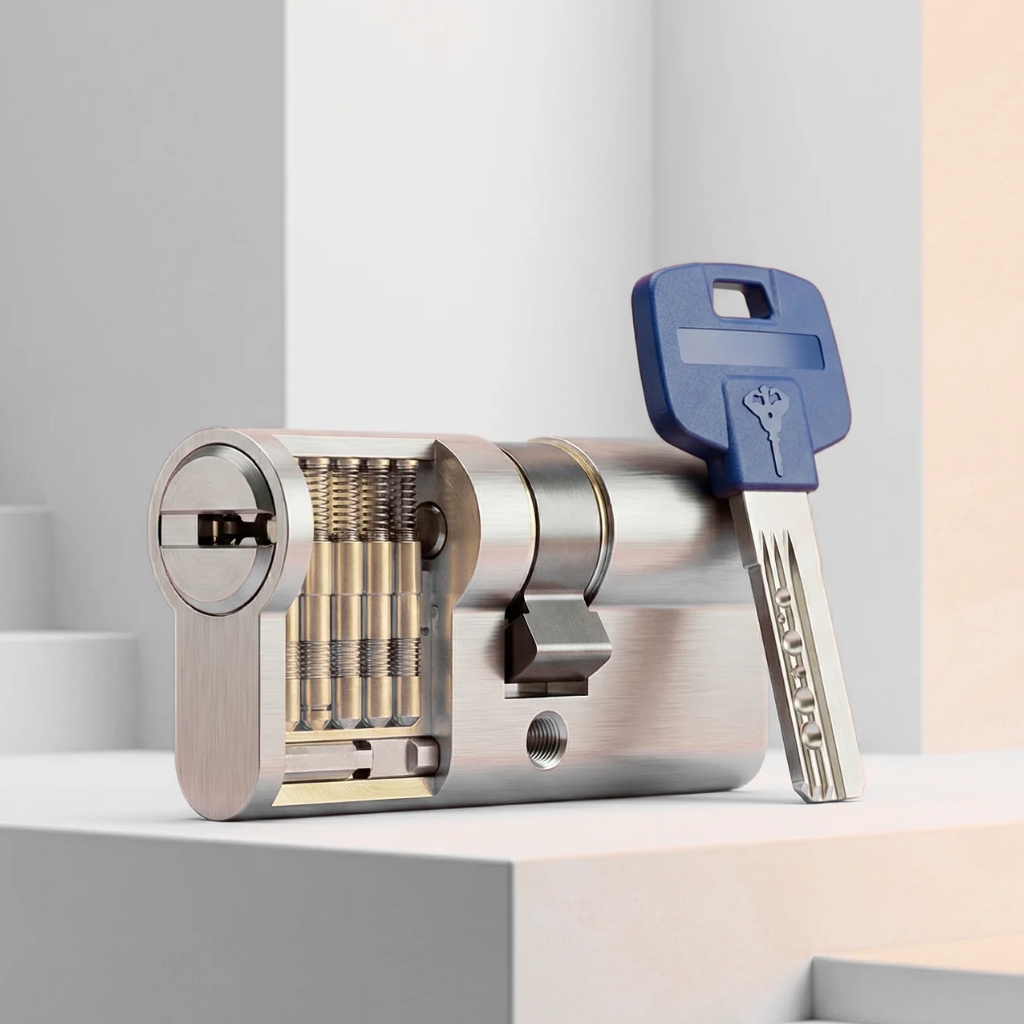
A high-security lock is usually a standard deadbolt or mortise body fitted with a better cylinder, and three things earn the name. Restricted keys, cut only by an authorised dealer to a registered code, so a key cannot be copied at a kiosk. Anti-pick design, such as telescoping pins, sidebars or rotating discs that defeat picking and bumping, plus hardened anti-drill inserts across the shear line.
Mul-T-Lock, Medeco and Abloy are the names you will see, and Safe & Secure Locksmith is a Mul-T-Lock dealer; the systems are compared on our high-security locks page. Rekeying a high-security cylinder is $60 to $120 per cylinder, and a restricted key cut to code with written authorisation is $30 to $80.
Lock grades: ANSI/BHMA Grade 1, 2 and 3 explained
ANSI/BHMA grades come from the Builders Hardware Manufacturers Association, which tests locks for operation, cycles, strength, security and finish and publishes the pass marks. Grade 1 is the top; Grade 3 is the minimum a certified lock can carry. The full standards are sold, but BHMA publishes highlight sheets for each.
For bored knobs and levers, BHMA's A156.2 highlights say a Grade 1 lock survives one million open-and-close cycles under a 10-pound axial load and seven security tests, including a 1,200 inch-pound torque on the locked lever. For deadbolts, the A156.36 highlights put Grade 1 at 250,000 cycles and a 1,350-pound force on the door against the bolt. Grades 2 and 3 pass the same categories of test at lower thresholds.
For residential hardware BHMA also runs a simpler Secure Home label: A, B or C for Security, Durability and Finish, with AAA the best. Real products show how the two line up: Schlage's B60 deadbolt is Grade 1 and AAA, its F51 keyed entry knob is Grade 2 and AAA, and Kwikset's 660 deadbolt is Grade 3.
The grade describes the lock, not the door. A Grade 1 deadbolt in a hollow door with a two-screw strike plate fails at the frame, which is why we look at the strike and the jamb before the hardware.
Which lock for which door: front, back, garage entry, bedroom and condo suite
- Front door: a Grade 1 or 2 single-cylinder deadbolt plus a keyed-entry lever or knob, keyed alike, on a reinforced strike. Add a keypad if keys are the daily problem.
- Back and side doors: the same deadbolt grade as the front, because that is where forced entry happens, and a double cylinder only if there is glass within reach.
- Garage entry door into the house: treat it as an exterior door with a full deadbolt, not a passage knob; the garage is the least-watched approach in Burnaby and Surrey.
- Bedrooms and bathrooms: privacy function, no key. Home office: privacy, or keyed entry if it holds work equipment.
- Condo suite: usually a Grade 2 deadbolt in a metal frame, often on the building's master key system, so any change has to keep the strata's key working. Ask before you swap.
- Older character home: keep the mortise case, upgrade the cylinder, and add a modern deadbolt above it.
A full door lock change, deadbolt and handle together, is covered under lock change in Vancouver.
Lock types compared: where each belongs, typical grade and price row
| Lock type | Where it belongs | Typical grade | Price row that applies |
|---|
| Single-cylinder deadbolt | Every exterior door | Grade 1 or 2 | Installed graded deadbolt $80 to $160; rekey $25 to $45 per cylinder |
| Double-cylinder deadbolt | Exterior doors with glass within reach | Grade 1 or 2 | Installed graded deadbolt $80 to $160 |
| Keyed-entry knob or lever | Exterior doors, paired with a deadbolt; offices | Grade 2 or 3 | Rekey $25 to $45 per cylinder; keys $5 to $15 |
| Privacy and passage knob or lever | Bedrooms, bathrooms, hallways, closets | Grade 2 or 3 | No cylinder to rekey; quoted on the call |
| Mortise lock | Pre-war houses, storefronts, commercial entrances | Grade 1 commercial | Commercial lock change $80 to $380 per door |
| Keypad or smart deadbolt | Front door, rental suite, short-term rental | Grade 1 or 2 | Installation quoted per model; cylinder rekey $25 to $45 |
| High-security cylinder (Mul-T-Lock, Medeco, Abloy) | Front door, commercial, anywhere keys must not be copied | Grade 1 body | High-security rekey $60 to $120 per cylinder; restricted key $30 to $80 |
Common questions
Is Grade 1 worth it for a house?
For the deadbolt, yes, if the door and frame are up to it; a Grade 1 deadbolt is tested to 250,000 cycles and a 1,350-pound push against the bolt, and the price gap to Grade 2 is modest. For interior knobs, no. Spend the difference on a four-screw strike plate into the stud.
Is a deadbolt enough?
A deadbolt is the lock that matters, but it is only as strong as the strike plate and the door edge. A one-inch throw, a reinforced strike screwed into the framing and long hinge screws let a Grade 2 deadbolt outperform a Grade 1 sitting in a weak frame.
Do I need both a knob lock and a deadbolt?
You need the deadbolt; the keyed knob is convenience. Most doors have both because the knob latches the door closed while the deadbolt is off. If the budget is tight, a passage knob and a good deadbolt beat a keyed knob with no deadbolt every time.
What is the difference between a deadbolt and a deadlatch?
A deadlatch is a spring latch with a small secondary pin that stops it being pushed back once the door is closed; it is what most commercial lever locks use. It beats a plain spring latch but it is not a deadbolt, and a door that relies on one usually gets a deadbolt added above it.
Article history
Published September 2026. Figures checked against the shop price sheet. Call 604-734-7233 or book a time.